LCOA Optimization Model
Team
Supervisor: Michael Rix
Location
Aachen, Germany
Year
2024
Role
Research Intern
SKILLS
Python, Mathematical Modeling, Data Analysis, Gurobi
Overview
I built a grid-connected extension to a green ammonia (eNRR) optimization model, using real hourly electricity prices to jointly size an electrolyzer and decide when to run it to minimize cost while meeting an annual NH₃ target. Comparing grid operation to an off-grid wind/solar setup shows that price-responsive operation can lower ammonia cost by concentrating production in cheap-power hours. This highlights operational flexibility as a key lever for making green ammonia more economically viable as grids add more renewables.
Background
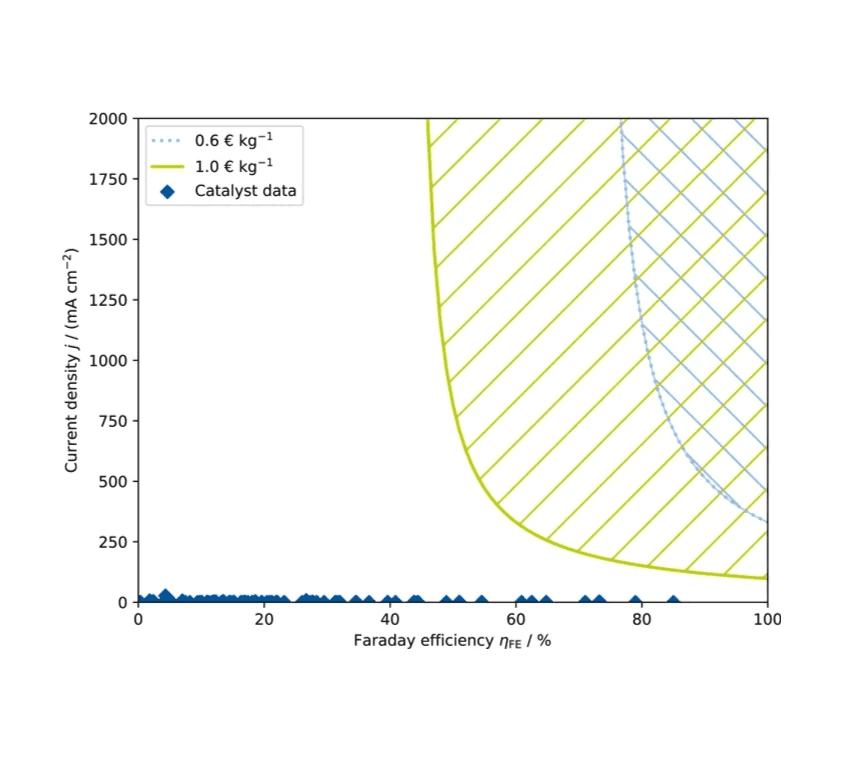
Ammonia is essential for fertilizer, but today it’s mostly made with fossil fuels, creating major CO₂ emissions. eNRR is a promising green ammonia production method that could produce NH₃ using electricity, but this plot shows current catalysts (blue) are still far from the performance needed to be cost-competitive (green). My project uses optimization modeling to translate that performance gap into concrete cost and operating requirements, thus showing how flexible, price-aware operation could make future eNRR systems more viable.
Limitations
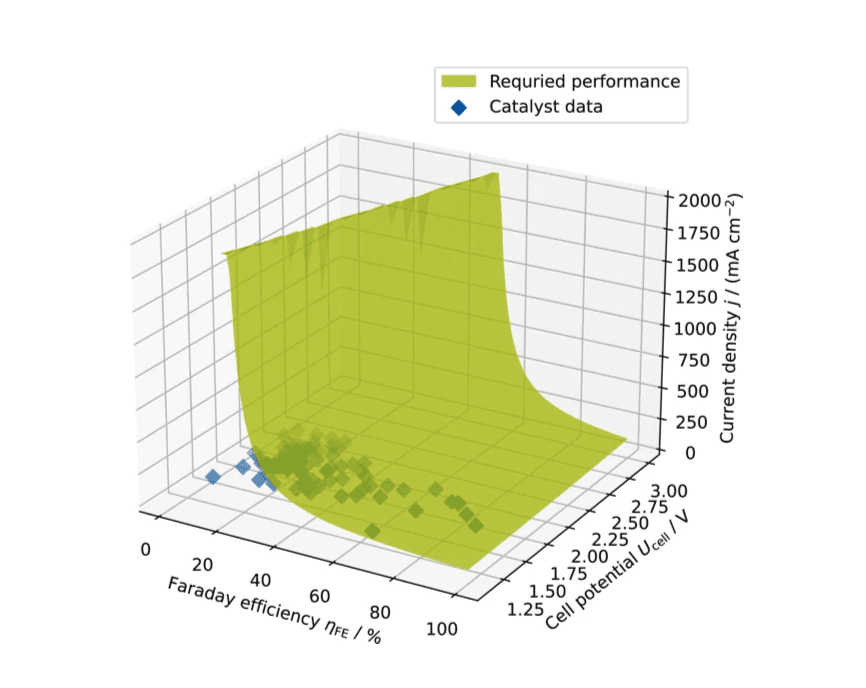
This 3D plot shows the key bottlenecks in eNRR today (blue): catalysts are too slow (low current density) and/or too energy-intensive (high cell voltage), so they fall far from the viable performance region (green). Closing the gap requires simultaneous gains in current density, Faradaic efficiency, and lower overpotential, and not just improving one metric at a time. My project ties these performance targets to real economics by optimizing electrolyzer sizing and price-responsive operation, showing what catalyst improvements and electricity conditions would make eNRR green ammonia scalable.
New Optimization Function
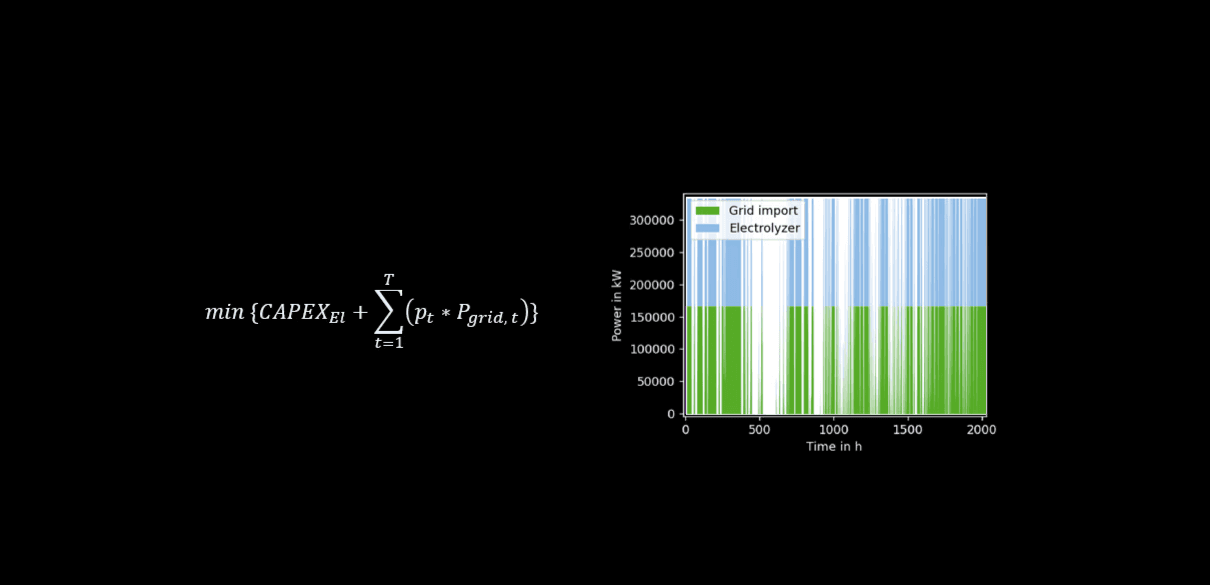
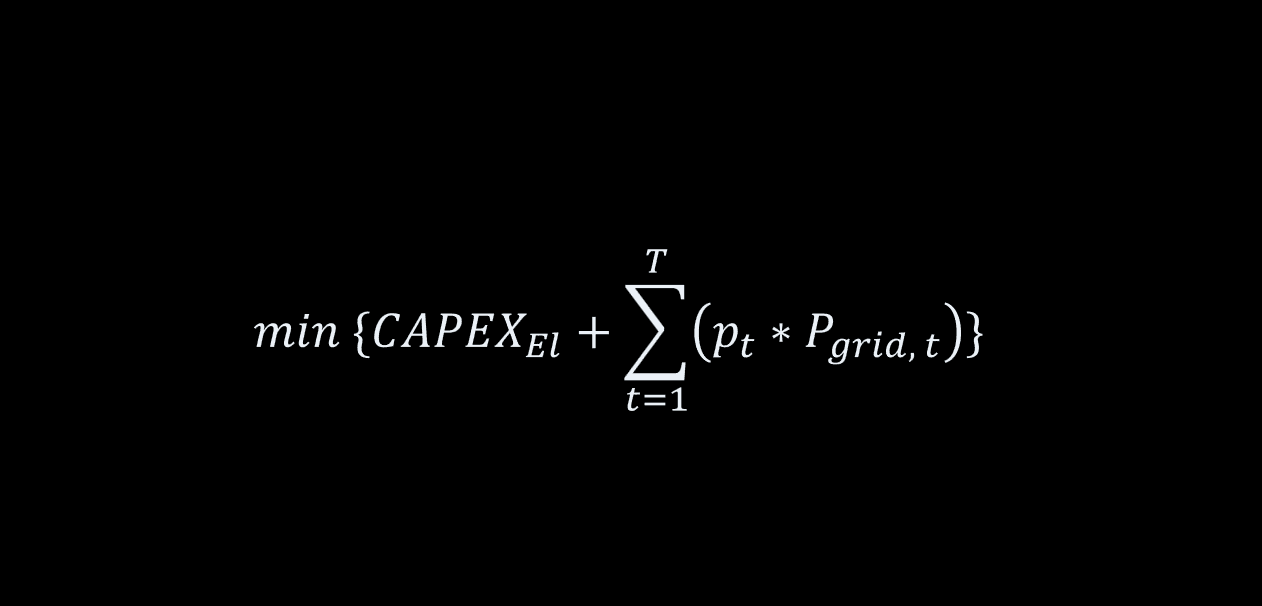
The grid-connected model replaces renewable sizing costs with a single cost-minimization that balances electrolyzer CAPEX against hourly electricity spending, minimizing electrolyzer CAPEX + electricity usage OPEX. Here p_t is the day-ahead price and P_grid,t is the power the electrolyzer chooses to draw each hour, so the optimizer naturally runs at full load in cheap hours and shuts off when prices are high while still meeting the fixed annual NH₃ target. This turns the electrolyzer into a price-responsive load and directly quantifies how electricity-price volatility impacts ammonia cost.
Code Demo
Running the Pyomo optimization model and generating plots for LCOA, capacity factor, and hourly dispatch behavior.
Results
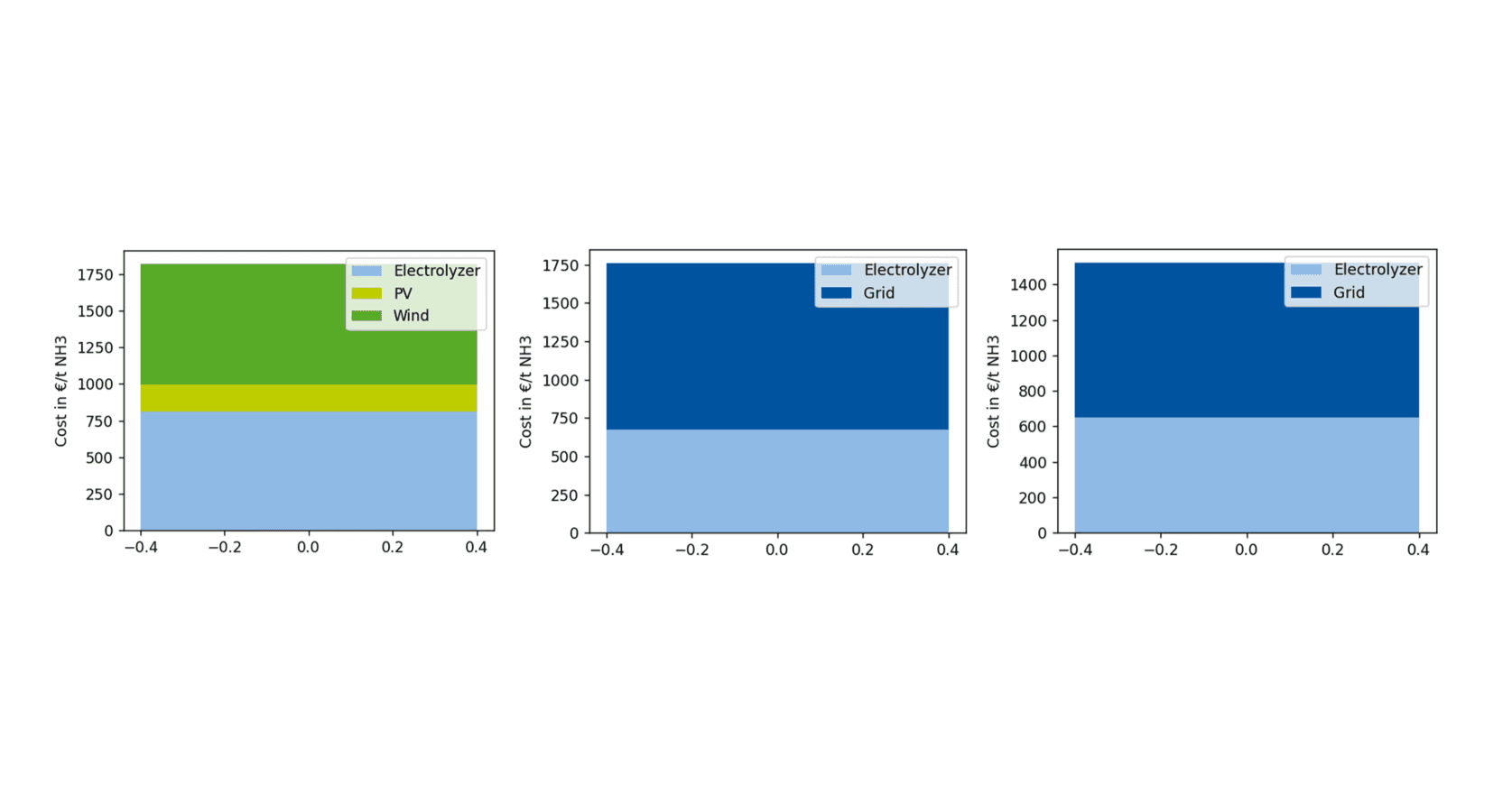
The model finds grid-connected operation is slightly cheaper than off-grid wind/PV for the studied case: €1,759/t NH₃ (Germany 2023 prices) vs €1,817.5/t NH₃ (Aachen 2023 renewables), a 3.2% reduction. Operation in grid mode is ideal by avoiding renewables CAPEX and concentrating production in cheap/negative-price hours, while off-grid systems must oversize and still curtail during peak generation. The broader takeaway is that operational flexibility is a major economic lever: a responsive electrolyzer can turn power-market volatility into lower LCOA by shifting production to favorable hours. This advantage holds mainly where the grid provides enough low-cost, increasingly renewable electricity, suggesting flexible green ammonia plants may scale fastest in those markets.
Off-Grid vs. Grid Curtailment
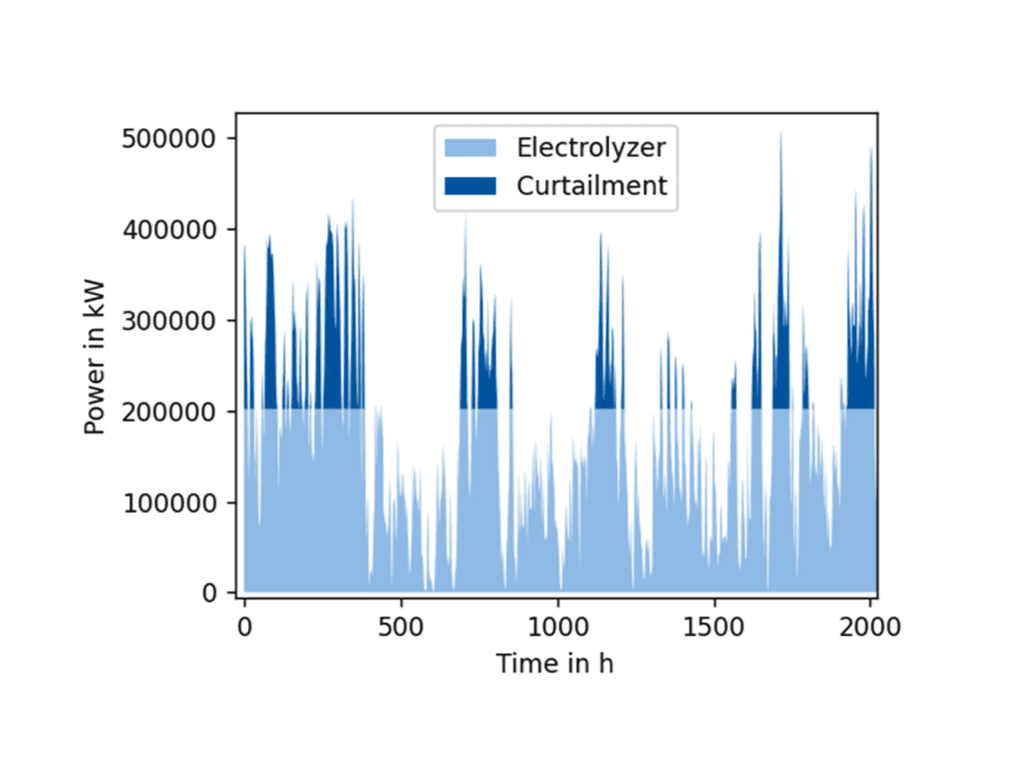
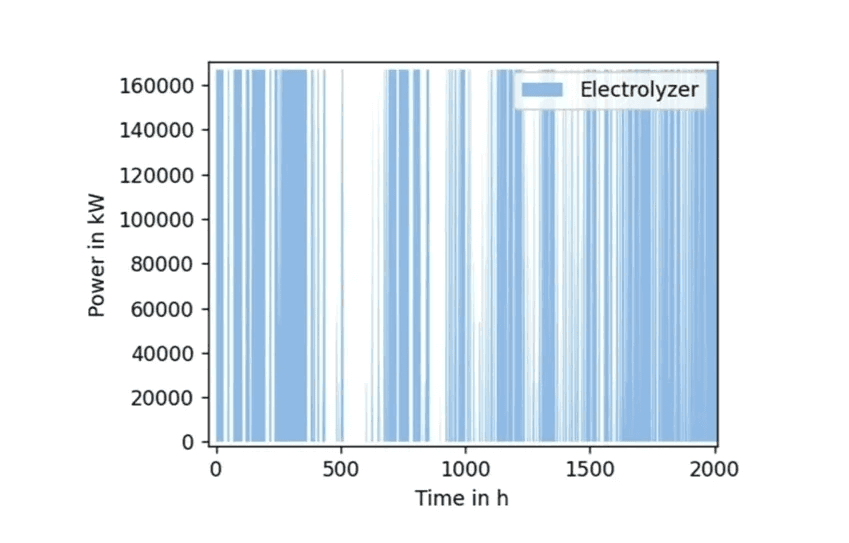
This plot shows two distinct cost-minimizing operating strategies. In the off-grid wind/solar case, the electrolyzer often runs at partial load because available renewable power fluctuates, and it is often cheaper to curtail excess generation than to oversize equipment to capture every peak hour (capacity factor ~66%). In the grid-connected case, the electrolyzer behaves in a binary on/off manner, running near full power in cheap hours and shutting down when prices are high, which leads to higher utilization (~81–83%). Overall, renewables mode minimizes cost by curtailing supply, while grid mode minimizes cost by curtailing demand, and the latter uses electrolyzer capacity more efficiently.
Conclusion
This project turns eNRR green ammonia from a lab performance question into tangible plant-level economics and operations question. By extending an existing renewables-based sizing model to a grid-connected, price-driven optimization, I showed that dispatch flexibility can reduce cost; i.e. in our studied case the grid mode produced slightly lower LCOA than off-grid wind/PV by running hard in cheap (often negative-price) hours instead of oversizing and curtailing generation. The bigger takeaway is where eNRR is most likely to scale first: markets with frequent low-cost, increasingly renewable electricity, where an ammonia plant can act like a flexible load. Overall, the model provides concrete operating and cost targets that help translate future catalyst improvements into deployable system designs.