Stonehenge
Team
Me!
Location
Baton Rouge, Louisiana
Year
2020-2024
Role
Individual Researcher
Info
This four-year research project was an eye-opening and rocky path towards my understanding of prehistoric Stonehenge innovators. I mathematically reverse-engineered a blind spot that exists in all previous Stonehenge studies: measuring instruments. Alongside this conclusion, I discovered a matching geometric pattern between Stonehenge and the lozenge artifacts. Based on this geometric pattern and fundamental ratios, I discovered prehistoric protractors and rulers from these gold lozenges, the fundamental unit of length behind the rulers, the application of this fundamental unit in the design and construction of Stonehenge’s concentric rings, and finally, the use of concentric rings and lozenge-based instruments to calibrate calendrical cycles with astronomical observation.
SKILLS
Reverse Engineering, User-Centric Thinking, Mathematical Modeling, Derivation
Overview
There is only one Stonehenge in the world. Academically speaking, this single site has inspired at least two academic fields, modern Archaeology pioneered by William Stukeley, and archaeoastronomy largely attributed to Norman Lockyer, Alexander Thom, and Gerald Hawkins.
However, despite this multi-century dissent between top scholars from diverse academic backgrounds, little agreement has been established regarding Stonehenge itself. While the claims of “solved” or “decoded” have been declared multiple times and later disproven, I took a rather unconventional approach, that is to reverse-engineer the design and operation of Stonehenge. It is the innovative thinking and practice behind the physical presence of Stonehenge that were critically concerned in this inquiry.
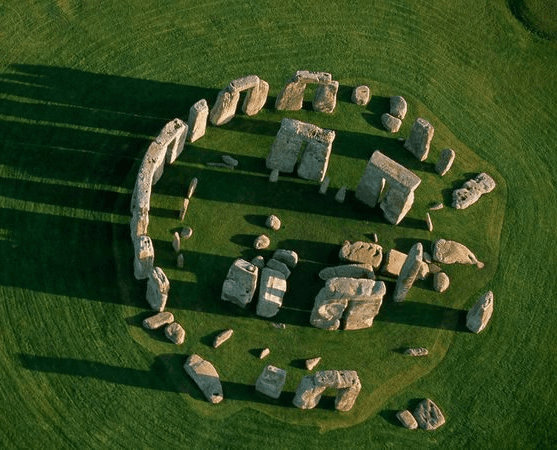
Stonehenge Site Plan
Thinking and visualizing from this birds eye perspective is the backbone of all findings, most crucially, when overlaying upscaled lozenge artifacts with the bird's eye site plan of Stonehenge.
Lozenge Artifact Models
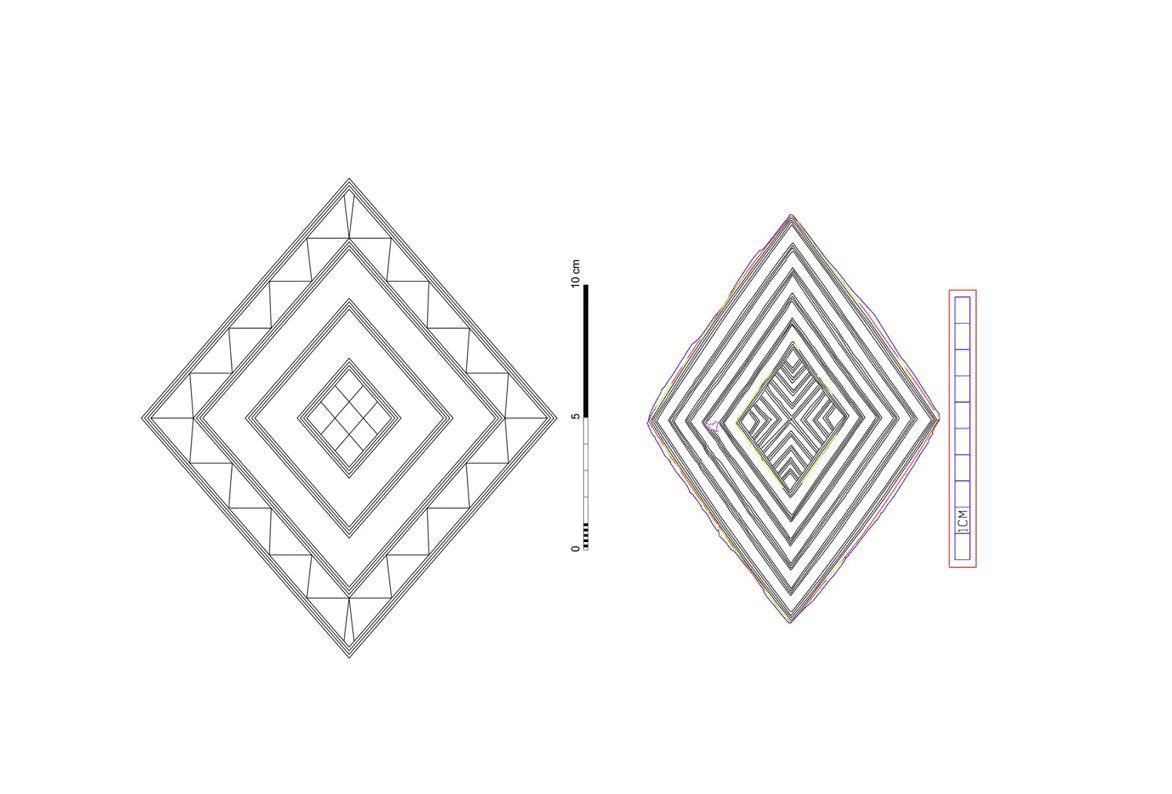
The Bush Barrow Lozenge (BBL, left) and the Clandon Barrow Lozenge (CBL, right) are the primary artifacts behind the pattern, protractor, design, and time-keeping mechanisms. Note the 1:1 ratio them.
Nested Square Pattern Derivation
This animation derives the shared geometric pattern between the layers and angles of lozenges and Stonehenge's site plan. The pattern can be constructed by rotating squares at 45° or inscribing circles and squares in sequence.
Mathematically | Equation |
|---|---|
Algebraically | X1 = 1; X2 = (X1+X3)/2; X3 =1/√2; Xi = Xi-2/√2 for i ≥ 4 |
Numerically | X = {1; 0.854; 0.707; 0.604; 0.5; 0.427; 0.3536; 0.302...} |
Approximately | X4 ≈ 3/5; X7/X2 ≈ 5/12 |
Trigonometrically | θi = arctan (Xi) for i ≥ 1: θ1= 45° Square θ2= 40.48° BBL θ3 = 35.26° CBL θ4= 31.13° BBS |
1:1000 Ratio
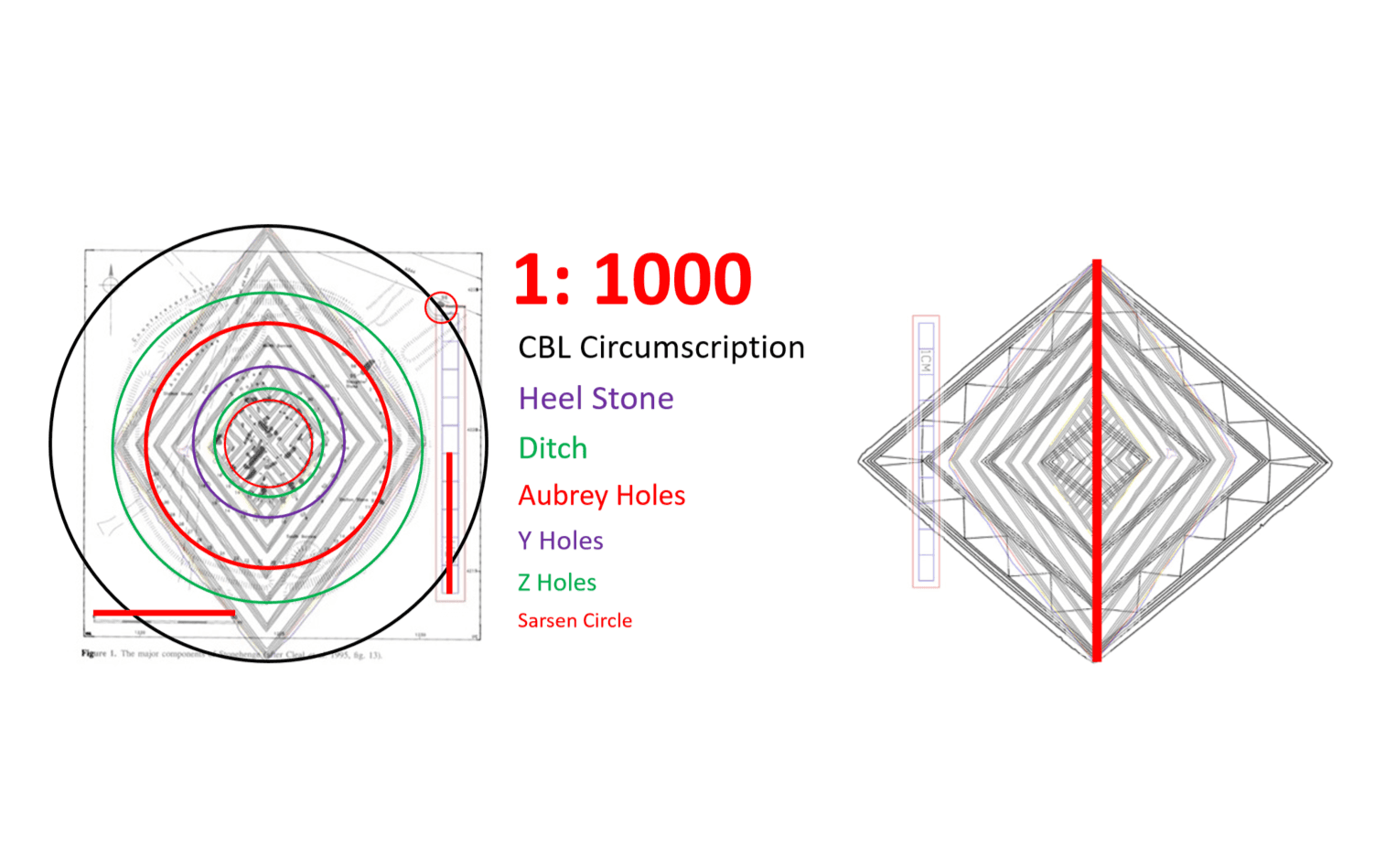
By circumscribing Aubrey Holes with the Clandon Barrow Lozenge (CBL), each ring of Stonehenge is circumscribed by a band on CBL, implying that Stonehenge also followed the same nested square pattern. Therefore, the nested square pattern is a Neolithic invention that lasted until the Early Bronze Age. It also justifies the existence of rulers with this unit before Stage 1 of Stonehenge.
Module Method (Method for the design and construction of Stonehenge)
This animation justifies that BBL and CBL are rulers of fundamental unit 1 Lozenge = 0.155m (shared length between long axis of CBL and short axis of BBL) through the module method. A decisive justification is that the Lozenge unit established a connection between the structure (number of holes) and scale of this circular ring (Aubrey Holes): i.e. the number of Aubrey holes = 560/10 =56 (circumference is 560 when measured in lozenges).
Furthermore, by reverse-engineering Stonehenge in the Lozenge unit, recurring π signatures emerge, indicating wheel-based measurement during Stage 1 construction (~3000 BCE).
Bush Barrow Lozenge established the cardinal orientation at the site of Stonehenge [2000 BCE]
By locating BBL’s eccentric pivot near the Sarsen Circle’s center, its zigzag geometry aligns with the circle’s gaps to generate clear 12° multiples, effectively locking the site to the cardinal directions and turning Stonehenge into a large-scale coordinate frame. Aligning the Station Rectangle with the same zigzag vertices furthermore fixes the east–west axis, letting the Avenue’s 40.5° orientation imply true north.
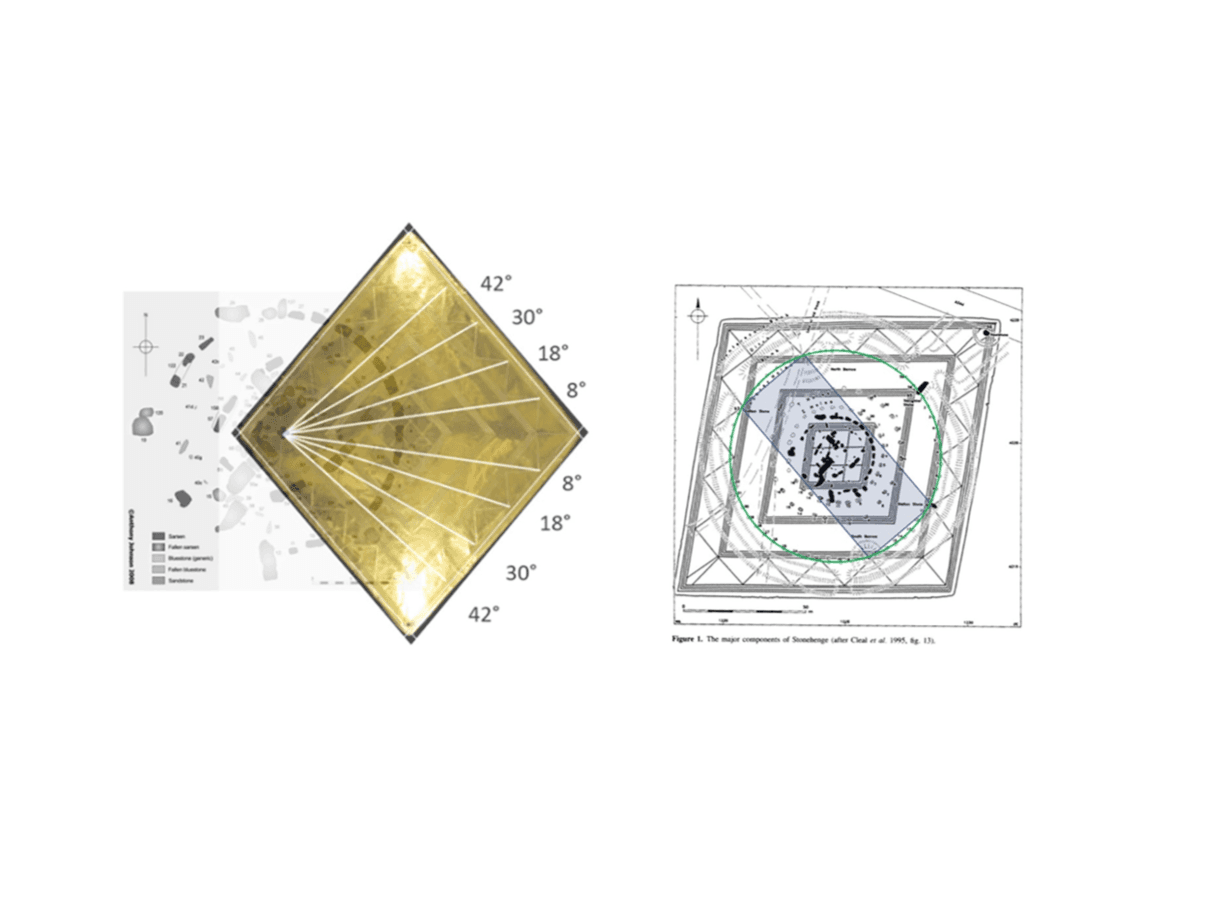
Protractor Mechanism (left animation)
This animation details that the gold lozenges (BBL and CBL) function as portable protractors, where eccentric pivots and elongated axes let them resolve small angles, and the nested-square angle sequence supplies enough near-integer values to support ~1° precision. A related piece (ULB) acts as a polar version with evenly spaced markings, and in combination with BBL/CBL can reach further precision.
When used within Stonehenge’s fixed, cardinally oriented stone geometry, these protractors effectively become compasses, turning measured angles into directions inside a stable site-scale coordinate frame. Finally, the same geometric framework supports a calendar interpretation: the 56 Aubrey Holes paired with the Avenue’s ~40.5° alignment is consistent with encoding a ~364/365-day solar scheme alongside lunar alignments.
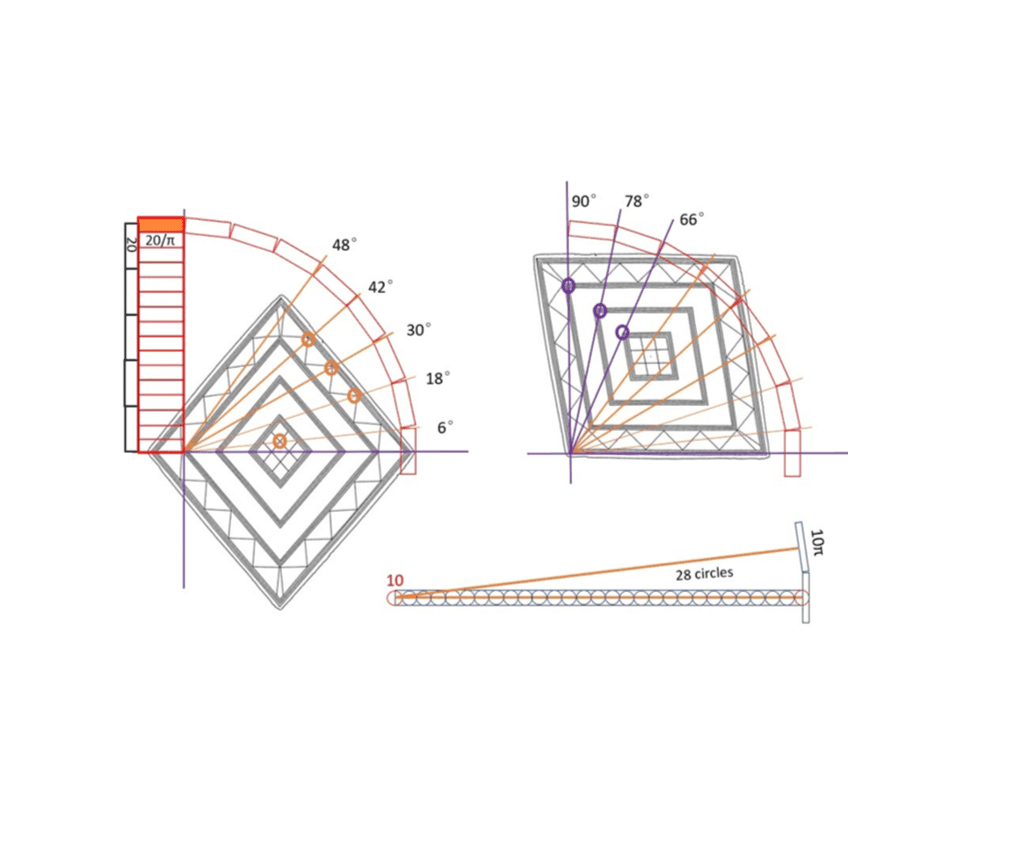
The practice of module-based N-Gon design existed throughout all stages of construction at Stonehenge
The 10π-Lozenge spacing at the 56 Aubrey Holes and the 20-Lozenge lintel length reveal the Lozenge as Stonehenge’s base unit and a module method for scaling rings as N-gons. Builders set a circle’s diameter or circumference to kN Lozenges (Aubrey: 10×56 in diameter; Sarsen: 20×30 in circumference).
Here, k is the module number, and the geometry is deliberately simple: circles, straight lines, and whole-number counts with no separate Euclidean construction for each N. This clean link between scale and structure breaks when other length units are used, supporting the module-based design.